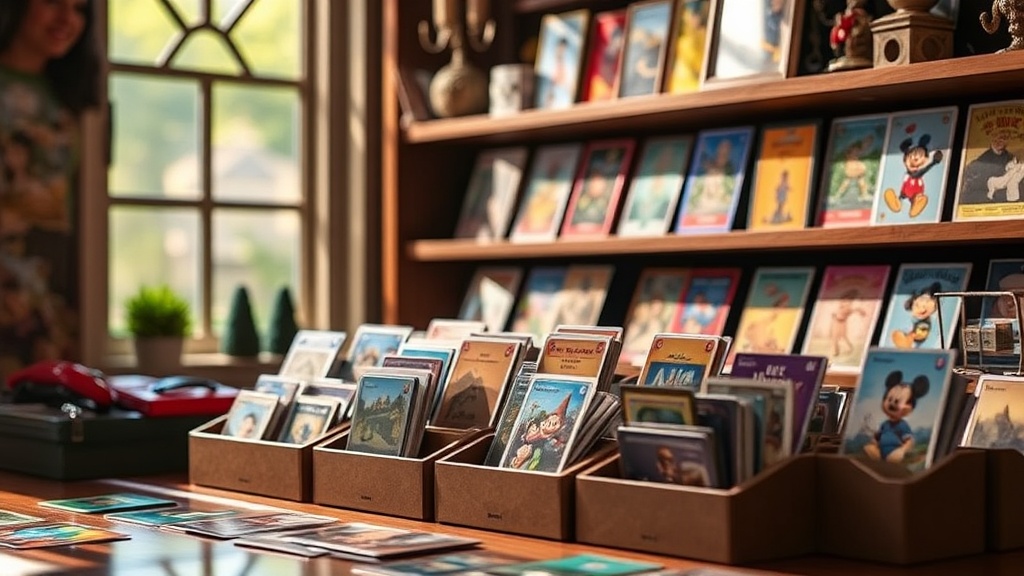
Preserving Your Disney Card Collection from Sunlight and Humidity

Exposure to direct sunlight can fade the ink on a high-value Disney trading card in as little as a few weeks. This post covers the specific ways light and moisture damage your collection and provides practical methods to prevent it. Protecting your investment requires more than just a nice shelf; it requires understanding the chemistry of paper and ink degradation.
How Does Sunlight Damage Disney Trading Cards?
Sunlight damages cards through UV radiation and thermal heating. Ultraviolet rays break down the chemical bonds in the ink and the paper fibers, a process known as photodegradation. If you've ever seen a vintage Disney card where the colors look washed out or "sun-bleached," you're seeing the direct result of UV exposure. Even if the card isn't in direct light, high levels of ambient UV can cause gradual fading over several years.
The heat from sunlight is just as dangerous. Heat causes the cardstock to expand and contract, which can lead to warping. If your cards are in plastic sleeves or top loaders, the heat can also cause the plastic to "off-gas" or stick to the card surface. This is a nightmare for collectors because once a card is stuck to a sleeve, the surface is often ruined forever. (I've seen it happen to more than one high-grade Mickey card—it's heartbreaking.)
To prevent this, you need to control two things: light intensity and light type. Most collectors use UV-resistant protectors, but these aren't a magic bullet. They slow down the process, they don't stop it. If you leave a card in a window, it's going to fade. Period.
When you're looking at displaying your cards, think about the ultraviolet spectrum. Most household LED bulbs don't emit much UV, but natural sunlight is incredibly intense. If you want to display a centerpiece card, do it in a room with blackout curtains or use UV-filtering glass on your display cases.
How Do You Protect Cards from Humidity?
Humidity protection involves maintaining a stable environment with low moisture levels to prevent mold, warping, and "foxing." High humidity levels—anything above 50-60%—can cause paper to absorb moisture from the air. This leads to several issues: the edges of the cards might soften, the paper might become wavy, and in extreme cases, you might even see small spots of mold or "foxing" (those brownish age spots you see on old paper).
The biggest enemy of a Disney card collector in a humid climate is the "sticky" feeling. When humidity is high, the card can feel slightly limp or damp. This is often a sign that the card is absorbing moisture, which can lead to permanent structural damage. If you live in a place like Florida or even parts of the Midwest during summer, this is a real threat.
Here's a breakdown of how moisture affects different storage materials:
- Standard Sleeves: Can trap moisture if not properly ventilated, leading to localized humidity issues.
- Top Loaders: Provide rigidity but can trap air that becomes damp if the room temperature fluctuates.
- Acrylic Cases: Great for display, but if they aren't airtight, humidity will still get in.
- Acid-Free Albums: These are the gold standard for long-term storage because they won't chemically react with the card.
I always suggest using silica gel packets in your storage bins. These little packets are designed to absorb moisture. Just be careful—if you use them in a closed container, you need to replace or reactivate them periodically. They don't last forever.
If you're serious about your collection, you might want to look into a dedicated dehumidifier for your office or hobby room. It's a better investment than buying a bunch of expensive sleeves that won't help if the air is already saturated with water. Keeping your environment stable is the most effective way to ensure your cards stay in "Gem Mint" condition.
What is the Best Way to Store Disney Cards Long-Term?
The best way to store cards long-term is in a cool, dark, and dry environment using acid-free materials. You want to avoid the "variable" environment. A stable room is much better than a room that swings 20 degrees in temperature every night. Constant changes in temperature and humidity are what kill collections.
Many people think that a basement or an attic is a good place to store things. That's a mistake. Basements are often damp and prone to mold, while attics get incredibly hot. Neither of these environments is suitable for paper-based collectibles. Your best bet is a climate-controlled room, like a living area or a dedicated office.
Let's look at a comparison of storage methods for different types of Disney cards:
| Storage Method | Best For... | Pros | Cons |
|---|---|---|---|
| Penny Sleeves | Temporary protection | Cheap, easy to find | No structural support |
| Top Loaders | Displaying single cards | Prevents bending | Can trap moisture if not careful |
| Magnetic Holders (One-Touch) | High-value "Grail" cards | Looks great, very protective | Expensive, heavy |
| Archival Binders | Large collections | Organized, easy to flip through | Can be bulky |
If you're dealing with high-value sets, I'd suggest a tiered approach. Keep your most valuable cards in magnetic one-touch holders, then put those holders inside a secondary airtight container or a high-quality storage box. This provides two layers of defense against the elements.
One thing to watch out for is the type of plastic you use. Not all plastics are created to be "archival." Some cheap plastics contain PVC (polyvinyl chloride). PVC is a problem because it can leach chemicals over time that actually eat away at the ink and the card surface. Always look for "PVC-free" or "Acid-free" labels on your sleeves and holders. If you aren't sure, it's probably not worth the risk for a high-value card.
It's also worth noting that how you move your cards matters. If you're taking your collection to a convention or a trade show, don't just throw them in a backpack. The pressure and the temperature changes in a car or a bag can cause issues. Use a dedicated, padded carrying case to keep them upright and protected.
When you're looking at your collection, you should be thinking about the long game. Are these cards for the joy of looking at them today, or are they assets for the future? If it's the latter, your storage habits are just as important as the cards themselves. If you're interested in the history of how these sets were made and why some are more fragile than others, you might find vintage Disney card eras helpful for context.
A lot of collectors spend thousands on the cards themselves but then spend pennies on the protection. That's a mistake. A $500 card in a $0.10 sleeve that's sitting in a humid corner is a $50 card waiting to happen. Treat the storage with the same respect you treat the collection. It's a simple way to ensure your pieces stay in great condition for decades.
Don't forget to check your storage every few months. Look for any signs of discoloration or warping. It's much easier to fix a small issue than to try and recover a collection that has already succumbed to mold or heat damage. A little bit of vigilance goes a long way.