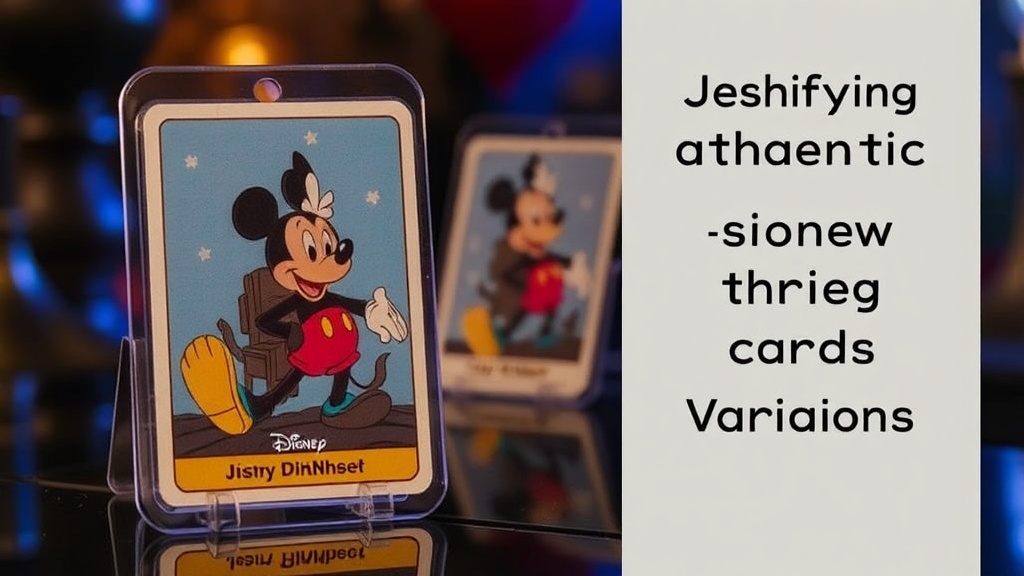
Identifying Authentic Disney Trading Card Variations

Have you ever unboxed a "rare" find only to realize the texture feels slightly off or the colors look washed out? Identifying authentic Disney trading card variations is a skill that separates casual collectors from serious investors. This guide covers the specific physical markers, printing techniques, and packaging indicators you need to verify the authenticity of your cards. Whether you're hunting for limited edition Disney pins or high-end trading card sets, knowing what to look for protects your investment.
How Do I Spot a Fake Disney Trading Card?
The most effective way to spot a fake is to examine the card's physical weight, the sharpness of the print, and the quality of the card stock. Authentic Disney trading cards—especially those from licensed sets like those found at Disney Parks—have a specific weight and a high-gloss finish that is difficult for counterfeiters to replicate perfectly. If a card feels flimsy or lacks a certain "snap" when you bend it slightly, it's likely a reproduction.
Look closely at the edges. Authentic cards feature clean, die-cut edges. If you see fraying or unevenness along the perimeter, be wary. Most high-end Disney trading cards use a multi-layered construction. This means there's a core layer between the printed front and back. A fake often lacks this structural integrity, feeling more like a standard piece of thin cardstock rather than a premium collectible.
Check the holographic elements. Many limited edition Disney cards use specialized foil or holographic patterns to denote rarity. On a real card, these patterns are crisp and integrated into the design. On a fake, the holographic effect often looks "pasted on" or blurry. It might even flake off if you rub it with your thumb (don't actually do this to a high-value card, though—use a magnifying glass instead).
The ink density is another giveaway. On authentic cards, the colors are vibrant and the black levels are deep. If the shadows in a character's outfit look grey or washed out, you're likely looking at a low-quality scan or a print job from a non-licensed printer. This is especially common with fan-made "custom" cards that attempt to mimic the official Disney aesthetic.
What Are the Different Types of Disney Card Variations?
Disney trading card variations generally fall into three categories: standard base sets, limited edition parallels, and error cards. Understanding these distinctions helps you realize why one card might be worth $5 while another is worth $500.
- Base Cards: These are the standard versions found in most retail packs. They have a consistent design and are the most common.
- Parallels (Refractors/Foils): These are "subset" cards that feature a different finish, such as gold, silver, or holographic patterns. They are much rarer than base cards.
- Error Cards: These are unintentional mistakes made during the printing process (like a misaligned image or a wrong color). While some collectors love them, they are often controversial in the community.
- Autograph Cards: These include a signature from a Disney animator or a character performer. These are highly sought after and should always come with verifiable proof of authenticity.
It's worth noting that many collectors get tripped up by "proxies." A proxy is a high-quality unofficial reproduction. While they aren't necessarily "fakes" intended to deceive, they aren't official Disney products. If you're buying from a secondary market, always ask if the item is an "official licensed product" or a "fan-made tribute."
If you're serious about your collection, you'll eventually need to worry about how these cards are kept. Once you've verified a rare card, you need to keep it in top shape. I've written about how to properly store and protect your Disney trading cards to ensure they don't degrade over time.
How Can I Verify the Authenticity of a Rare Card?
You can verify authenticity by comparing the card against known high-resolution images of the official set or by using a jeweler's loupe to inspect the printing-dot pattern.
The "dot pattern" trick is a pro move. If you look at a standard printed image under a magnifying glass, you'll see a pattern of tiny dots (the CMYK process). On an authentic Disney card, this pattern is extremely fine and consistent. If the dots look huge, uneven, or if you see "digital noise" in the shadows, the card was likely printed on a consumer-grade printer rather than an industrial press.
Another method is checking the back of the card. Most official Disney trading card sets have a very specific font and layout on the reverse side. The weight of the ink on the back should match the front. If the back looks much lighter or "faded" compared to the front, it's a red flag. Also, check for the copyright-holder information. Even if it's a small print, it should be legible and match the official Disney-approved text for that specific series.
| Feature | Authentic Disney Card | Counterfeit/Proxy Card |
|---|---|---|
| Edge Quality | Sharp, clean, die-cut | Frayed, uneven, or soft |
| Holographic Effect | Integrated, crisp, vibrant | Blurry, "pasted on," or weak |
| Card Weight | Substantial, "snappy" feel | Light, flimsy, or "paper-like" |
| Color Depth | Deep blacks, high saturation | Grey shadows, washed-out colors |
Don't forget to check the manufacturer's stamp or the official logo. Many high-end collections are produced by specific companies like Topps or other licensed partners. If the card lacks the expected manufacturer branding, it's a major red flag. You can often find these details on the Wikipedia page for trading card games to see how different brands structure their official releases.
Common Red Flags to Watch For
The most obvious red flag is an unrealistic price. If someone is selling a "one-of-a-kind" Mickey Mouse holographic card for $10 on a random marketplace, it is almost certainly a fake. Scammers often use high-quality photos of real cards to sell low-quality reproductions.
Another red flag is the lack of a serial number. Many high-end Disney cards are "numbered" (e.g., 01/500). This means only 500 copies of that specific card exist in the world. If the card is supposed to be a numbered limited edition but doesn't have a visible, cleanly printed number on the front or back, it's a fake. The number should be etched or printed with the same precision as the rest of the card design.
The packaging can also tell a story. If you're buying a sealed box or pack, look at the seals. Are they glued properly? Is the branding consistent with what you see in retail stores? A poorly sealed box is a sign that it might have been "tampered" with—meaning someone could have swapped out the rare cards for common ones before resealing it. This is a common tactic in the collecting world.
One more thing: pay attention to the scent. It sounds weird, right? But a freshly printed, high-quality card has a very specific, neutral smell. If a card smells like heavy ink or cheap chemical coatings, it might have been printed recently on non-professional equipment. It's a small detail, but it's a detail that experienced collectors use to vet their purchases.
As you build your collection, you'll likely want to show it off. Once you've vetted your cards, you might want to look into setting up a professional display to keep them looking their best.
Authenticating Disney cards requires a mix of patience, a keen eye, and a bit of skepticism. Don't be afraid to ask for more photos or even a video of the card being tilted in the light. A seller with nothing to hide will always be happy to provide the proof you need to feel confident in your purchase.