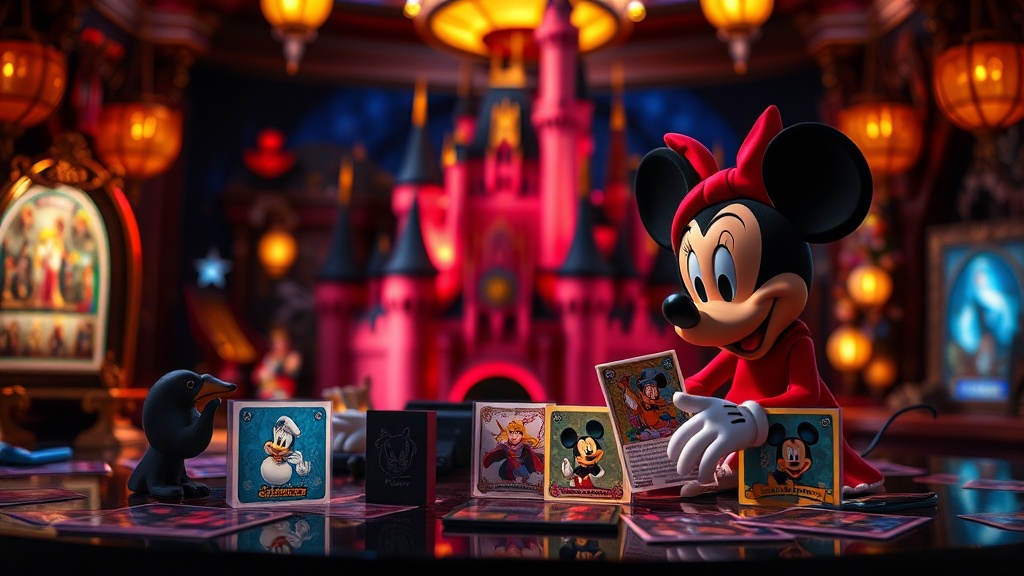
What Separates Ordinary Disney Cards From True Collector's Pieces?

This listicle breaks down the specific factors that distinguish common Disney trading cards from the ones serious collectors chase. You'll learn what drives real value, which attributes actually matter, and how to spot cards worth holding onto—whether you're browsing estate sales, auction sites, or your own childhood collection.
Which Card Grades Actually Justify the Premium Price?
Grading companies like PSA and CGC have turned condition assessment into a science—but not every grade warrants the same attention. PSA 10 Gem Mint cards command serious premiums, sometimes 5x to 10x over raw (ungraded) equivalents. PSA 9s? They're excellent cards, but the price jump from 9 to 10 can be staggering depending on the set.
Here's where it gets interesting: some collectors intentionally target PSA 8s and 9s. Why? Because the visual difference between an 8 and a 10 is often imperceptible to the naked eye, yet the cost savings are substantial. For vintage Disney cards from the 1970s and 1980s, even a PSA 7 can represent a genuinely difficult find in acceptable condition.
When considering grading costs—roughly $15 to $50 per card depending on turnaround time and declared value—you need to run the math. A $5 common card graded PSA 10 isn't suddenly worth $200 unless it's from an exceptionally scarce set. Focus your grading budget on cards with established secondary markets: early Trading Card Database entries from Skybox, Impel, and Upper Deck's Disney premium lines.
Why Do Some Characters Consistently Outperform Others?
Mickey Mouse cards don't automatically equal gold. Neither do Princess cards. The character-value relationship is more nuanced—and that's where opportunity hides for observant collectors.
Villains consistently punch above their weight. Maleficent, Ursula, Scar—these characters have passionate, dedicated collector bases willing to pay premiums for high-grade examples. Sidekicks are another sleeper category: Genie cards from Aladdin, Timon and Pumbaa from The Lion King, and Sebastian from The Little Mermaid all show stronger appreciation curves than you'd expect.
Modern characters have shorter track records, but early data suggests Moana and Encanto cards are developing collector followings faster than typical release patterns. The lesson? Character popularity in the broader Disney ecosystem doesn't always translate directly to card values—but character scarcity within specific sets absolutely does. When a character only appears on one or two cards in a 100-card set, those cards become de facto chase cards regardless of who the character is.
Which Production Variants Create Genuine Scarcity?
Disney card printing runs have quirks—and the variants born from those quirks are where serious collectors focus their attention. Understanding these distinctions separates hobbyists from investors.
Error Cards Worth Tracking Down
Miscuts, missing foil stamps, and color registration errors can transform ordinary cards into conversation pieces. The key distinction: factory errors versus damage. A card that left the printing press with a blank back is an error. A card that got creased in your pocket is damaged. Only one category carries premium value.
Particularly interesting are "wrong back" errors—cards from one set printed with backs from another. These are exceedingly rare in Disney issues but do exist, primarily in 1990s Upper Deck and Skybox productions. When authenticated, they command significant interest.
Parallel and Insert Intensity
Chrome refractors, holographic overlays, embossed textures—parallel cards (design variations within the same set) create artificial scarcity through limited production runs. First-edition indicators, serial numbering, and manufacturer-stated print limits all factor into relative rarity calculations.
Look for the "numbered to" notation: cards with explicit production caps (like "48/100") have documented scarcity. Unnumbered parallels rely on collector consensus about relative rarity, which is less reliable but still meaningful in established sets with years of population data.
Where Are Collectors Actually Finding Undervalued Cards?
The hunt matters as much as the find—and knowing where to look gives you measurable advantages over collectors who only browse eBay sold listings.
Estate sales in suburban Midwest and Florida regions consistently produce Disney card discoveries. Retirees who collected in the 1990s—or whose children did—often have complete sets sitting in climate-controlled storage. The key is arriving early and knowing what to look for: sealed wax boxes, complete factory sets in original packaging, and promotional cards from theatrical releases or Disney Store grand openings.
Local card shops represent another underutilized source. Many shop owners focus on sports and don't recognize Disney card values. A $50 box of "oddball non-sport cards" might contain several hundred dollars of Disney premiums if you know the product lines. Build relationships with these dealers—they'll call you when Disney lots arrive rather than pricing them individually.
International markets offer arbitrage opportunities. Japanese Disney card releases—particularly those tied to phone cards, candy premiums, or Peko-chan collaborations—have strong domestic followings that don't always translate to Western pricing awareness. French and Italian Disney card issues from the 1980s and 1990s similarly operate in pricing silos that savvy collectors exploit.
What Documentation Protects Your Investment Long-Term?
Provenance—documented ownership history—matters more in Disney card collecting than most hobbyists realize. It's not just about authenticity; it's about establishing the narrative that makes a card collectible rather than merely old.
Keep original purchase receipts when possible. Document where you acquired cards, from whom, and under what circumstances. Photograph significant finds in context—the estate sale table, the card shop display, the convention booth. These records become valuable if you ever sell, but more importantly, they help you remember why you valued particular pieces.
For high-value acquisitions, consider third-party authentication even for raw cards. While grading provides encapsulation and numeric assessment, authentication services specifically verify that cards are genuine production pieces rather than counterfeits or reprints. The Disney card market—like all collectible markets—sees periodic waves of sophisticated fakes, particularly for high-profile vintage issues.
Which Collection Strategies Build Real Value Over Time?
Complete set building versus single-card focus: both approaches work, but they serve different collector profiles and risk tolerances.
Complete sets provide satisfaction and immediate visual impact. They're also easier to liquidate quickly when needed—one buyer, one transaction, one shipping event. The downside? You're necessarily acquiring common cards that may never appreciate significantly to subsidize the chase cards that drive set value.
Single-card focus allows concentrated investment in genuinely scarce pieces. A collection of twenty PSA 9+ vintage Disney chase cards represents more portable wealth than twenty complete common sets. The approach requires deeper research, stronger authentication skills, and patience—but the ceiling is higher.
Hybrid strategies work too: building complete sets of modestly priced series while maintaining a separate "trophy case" of individual high-grade cards from premium releases. This gives you the satisfaction of completion alongside the security of concentrated quality.
When Should You Hold Versus Liquidate?
Disney card values fluctuate with broader entertainment collectible trends—and with Disney's own corporate narrative. Major film anniversaries (25th, 50th) create temporary demand spikes. Live-action remakes often rekindle interest in original animated series cards. Theme park milestone celebrations drive nostalgia purchases.
The discipline is recognizing cyclical peaks. When mainstream media covers Disney collectibles—often around major film releases or corporate events—prices inflate temporarily. This is typically liquidation opportunity for common pieces, not acquisition timing. Conversely, when Disney card discussions vanish from collector forums and auction activity slows, that's when patient buyers find their best opportunities.
Your personal collecting timeline matters too. Cards you're holding for retirement funding require different liquidity planning than cards you're collecting for enjoyment with potential appreciation as a bonus. Be honest about your goals—both approaches are valid, but mixing them creates confusion and suboptimal decision-making.