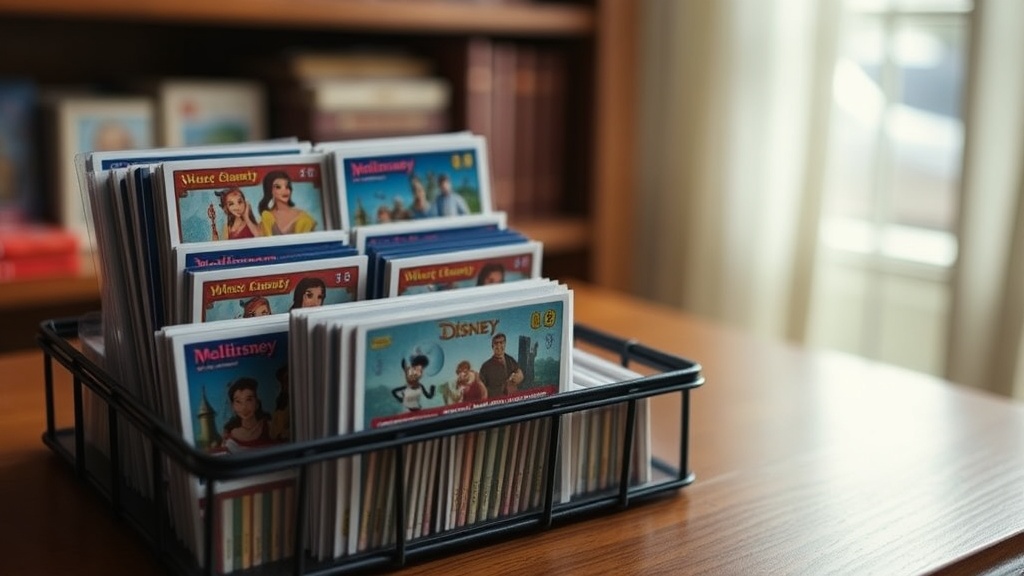
How to Properly Store and Protect Your Disney Trading Card Collection

What's the Best Way to Store Disney Trading Cards?
The best way to store Disney trading cards depends on the collection's size, value, and how often cards are handled. For casual collectors with a few dozen cards, a simple binder with side-loading pockets works fine. Serious collectors with rare Disney Lorcana legendaries or vintage Sorcerers of the Magic Kingdom cards need a multi-layer approach—sleeves, toploaders, and climate-controlled storage. The goal is protecting cards from the three main threats: moisture, UV light, and physical damage from handling.
Disney cards come in many varieties. You've got the massive Disney Lorcana trading card game by Ravensburger, the classic Sorcerers of the Magic Kingdom game cards from Walt Disney World, decades of park-exclusive promotional cards, and third-party sets like those from Upper Deck or Topps. Each type has different sizes, finishes, and vulnerabilities. Lorcana cards, for example, have a slightly glossy finish that's prone to scratching if not sleeved properly.
The foundation of any storage system starts with card sleeves. Penny sleeves—those thin, clear polypropylene sleeves—cost next to nothing and provide basic protection against fingerprints and surface wear. You'll want to double-sleeve anything valuable, which means using a perfect fit sleeve (like the KMC Perfect Size) inside a standard sleeve. This creates an airtight seal that keeps dust and moisture out.
Binders remain the most popular storage method for active collections. The key is choosing the right one. Look for D-ring binders instead of round rings—rings that don't close perfectly can crimp card corners. Side-loading pockets prevent cards from sliding out when the binder moves. The Ultra Pro Pro-Binder uses this design and holds 360 cards across 20 pages. For larger collections, the Dragon Shield Card Codex offers a zippered closure and padded cover, which adds drop protection if the binder falls.
Here's the thing about binders: they're not for long-term storage of high-value singles. Every time you open that binder, you're introducing cards to air, light, and handling risks. For cards worth more than $50—think enchanted rarity Lorcana cards or limited edition park promos—you'll want something more secure.
How Should You Protect High-Value Disney Cards?
High-value Disney cards should be stored in semi-rigid or hard plastic holders with desiccant packs, kept in a dark, temperature-stable environment. This means toploaders or magnetic one-touch cases for individual cards, stored inside card storage boxes or safes. The BCW Semi-Rigid holders work well for cards under $100, while magnetic one-touch cases from Ultra Pro UV ONE-TOUCH provide museum-grade protection for grail cards.
Let's talk about the environment first. Trading cards are essentially paper and ink sandwiched between layers of coating. Paper expands and contracts with humidity changes. Too dry? The card becomes brittle. Too humid? You've got curling, warping, and (worst case) mold. The sweet spot is 45-55% relative humidity. You'll need a hygrometer—those little digital humidity monitors cost about $10 at any hardware store. Check it weekly.
Temperature matters too. Attics and garages are card graveyards. Heat accelerates the breakdown of adhesives in card stock. Cold can make cards brittle. Shoot for 65-70°F (18-21°C)—normal room temperature. If your storage area feels uncomfortable for humans, it's wrong for cards.
For individual protection, toploaders are the standard. These rigid plastic sleeves come in different thicknesses. Standard trading cards fit in 35pt toploaders. Some Disney cards—particularly thicker promotional cards or special editions—might need 55pt or 75pt. Measure your card with a caliper if unsure. The catch? Toploaders don't seal. Dust gets in. You'll want to team them with a perfect-fit sleeve inside.
Magnetic one-touch cases take protection further. These clamshell holders use magnets to seal shut, creating a nearly airtight environment. Many have UV-resistant coatings. The Card Saver 1 by BCW is a favorite among collectors shipping cards for grading—semi-rigid but protective enough for PSA, CGC, or Beckett submissions. For display purposes, magnetic cases from Ultra Pro or Vault X look sharp on a shelf while keeping cards pristine.
Worth noting: graded cards come encapsulated in plastic slabs. Don't store these loose in boxes where they can rattle against each other. Use graded card storage boxes—BCW makes one that holds 30-40 graded cards with foam padding between slots.
Creating the Right Storage Environment
Once individual cards are protected, think about the container. Cardboard storage boxes work for bulk commons and uncommons. The BCW Storage Box comes in 400-count and 3200-count sizes, made from acid-free cardboard. For anything valuable, upgrade to a fireproof document safe. SentrySafe makes affordable options ($80-150) that protect against fire and minor water damage. Add silica gel packets inside—those little "do not eat" packets absorb moisture. Replace them every few months (you can recharge them in an oven).
Light exposure destroys cards over time. UV rays fade colors and break down chemical bonds in card stock. Never store cards in direct sunlight. If displaying cards, use UV-protective acrylic cases. Better yet—rotate displayed cards every few weeks and keep the collection in darkness.
What Storage Supplies Do Collectors Recommend?
Experienced collectors recommend specific brands and products based on testing and community consensus. Ultra Pro, BCW, Dragon Shield, and KMC dominate the conversation for good reason—these companies have refined their products over decades. That said, "best" varies by use case. A collector organizing thousands of bulk Lorcana commons has different needs than someone preserving a single signed Disney artist proof card.
The table below breaks down recommended products by category and typical use case:
| Product | Best For | Price Range | Why Collectors Choose It |
|---|---|---|---|
| Ultra Pro Penny Sleeves | Bulk protection, all cards | $1-2 per 100 | Consistent sizing, no residue |
| KMC Perfect Fit Sleeves | Inner sleeve for double-sleeving | $5-7 per 100 | Tight fit, archival safe |
| Dragon Shield Matte Sleeves | Deck storage, handling | $10-12 per 100 | Extremely durable, great shuffle feel |
| Ultra Pro Toploaders (35pt) | Individual card protection | $3-5 per 25 | Crystal clear, standard sizing |
| BCW Semi-Rigid Card Saver 1 | Grading submissions | $8-12 per 50 | PSA/CGC preferred, snug fit |
| Ultra Pro Magnetic One-Touch (35pt) | High-value display storage | $3-4 each | UV protection, premium look |
| Ultra Pro Pro-Binder | Active collection viewing | $20-30 | Side-loading, lays flat |
| BCW 3200-count Storage Box | Bulk commons storage | $5-8 | Acid-free, stackable |
| Dragon Shield Card Codex | Portable collection | $35-45 | Zippered, padded, premium build |
One mistake new collectors make: buying the cheapest supplies on Amazon. Off-brand sleeves can have sizing inconsistencies—too tight and they damage card edges, too loose and cards slide around. Some cheap sleeves use PVC (polyvinyl chloride) which releases acids over time, yellowing and damaging cards. Stick to polypropylene or polyethylene materials. The extra dollar per pack isn't worth risking a $200 graded card.
For Disney Lorcana specifically—currently the hottest Disney card property—consider how you play versus collect. Cards in active decks see constant handling. Use Dragon Shield or Katana Sleeves (made by Sleeve Kings) for play. These are thicker, textured for shuffling, and protect against the oils from fingers. Reserve thin penny sleeves for storage-only cards.
Handling Cards Safely
Supplies only work if you handle cards correctly. Always wash hands before touching unsleeved cards—better yet, use cotton gloves for valuable vintage pieces. Handle cards by the edges, never the face. Finger oils leave residue that attracts dust and can etch into glossy finishes over time. When removing cards from packs, use a clean surface. Those kitchen tables with crumbs and moisture? Card killers.
For cleaning existing cards—don't. Seriously. Don't wipe cards with cloth, don't blow on them (saliva particles), don't use compressed air (chemical propellants). A soft camel hair brush can remove surface dust from toploaders, but never touch the card surface directly. If a card has smudges or residue, leave it. Attempting cleaning usually causes more damage. Professional conservators exist for museum pieces, but for trading cards, condition is permanent.
Insurance and Documentation
Worth noting for serious collectors: document everything. Photograph high-value cards, keep purchase receipts, and maintain a spreadsheet of acquisition dates and prices. For collections valued over $5,000, consider collectibles insurance. Collectibles Insurance Services and similar specialty insurers cover trading cards with policies separate from homeowners insurance (which often has low limits and high deductibles for collectibles).
Store documentation separately from the collection. Cloud backups of spreadsheets, photos stored on multiple drives—if disaster strikes, you'll need proof of what you owned. Some collectors keep a small notebook in their safe with the collection overview. Low-tech, but fireproof safes protect paper just fine.
Disney cards occupy a unique niche. They're not just game pieces or investments—they're tied to memories, nostalgia, and one of the world's most powerful entertainment brands. Whether you're safeguarding a complete set of Disney Lorcana: The First Chapter or a handful of vintage park-issued cards from the 1980s, proper storage preserves both monetary value and sentimental worth. Start with sleeves and a good binder. Upgrade protection as values increase. Monitor your environment. And handle every card like the piece of magic it represents.
Steps
- 1
Choose the Right Card Sleeves and Protectors
- 2
Organize Cards in Binders or Storage Boxes
- 3
Control Temperature and Humidity Levels